Beyond the Narrative: Where Mental Health Myths, Trends & Truths Collide
By Nitin Shah
CEO, ICHARS & Director, ICHARS Support Foundation
We Tell Men to Be Strong. But What Do We Really Mean by Strength?
From an early age, many boys grow up hearing messages like:
“Boys don’t cry.”
“Be strong.”
“Man up.”
“Handle it yourself.”
Most of these messages are shared with good intentions. Parents want their children to become resilient. Teachers encourage perseverance. Coaches value discipline. Society often celebrates responsibility and self-reliance.
None of these qualities are inherently harmful.
In fact, resilience, responsibility, and perseverance are essential for navigating life’s challenges.
The difficulty begins when strength becomes narrowly defined—when emotional restraint is mistaken for emotional health, vulnerability is viewed as weakness, and seeking help feels less acceptable than suffering in silence.
Over time, these messages can shape how men understand not only strength but also their relationship with emotions.
Many become skilled at appearing composed while quietly carrying stress, self-doubt, grief, burnout, or emotional pain that remains unseen by those around them.
The conversation about men’s mental health is therefore much bigger than whether men cry.
It is about how society teaches boys and men to recognise emotions, express vulnerability, build resilience, and seek support when they need it.
The answers to these questions influence far more than individual wellbeing.
They shape families.
They influence educational institutions.
They affect workplaces.
They determine how communities respond to emotional challenges.
Ultimately, they shape the kind of society we create together.
What Is Men’s Mental Health?
Men’s mental health refers to the emotional, psychological, and social wellbeing of men. It influences how they think, feel, respond to stress, build relationships, make decisions, and seek support during difficult times.
It is not defined by the absence of emotional struggles.
Nor is it determined by whether someone cries.
Rather, it reflects a person’s ability to understand emotions, cope with life’s challenges, maintain healthy relationships, and access support when needed.
According to the World Health Organization (WHO), mental health is an integral part of overall health and wellbeing. It affects how people realise their abilities, cope with life’s normal stresses, work productively, and contribute to their communities.
Understanding men’s mental wellbeing through this broader lens shifts the conversation away from stereotypes and towards creating environments where emotional wellbeing is recognised as an essential part of living a healthy and meaningful life.
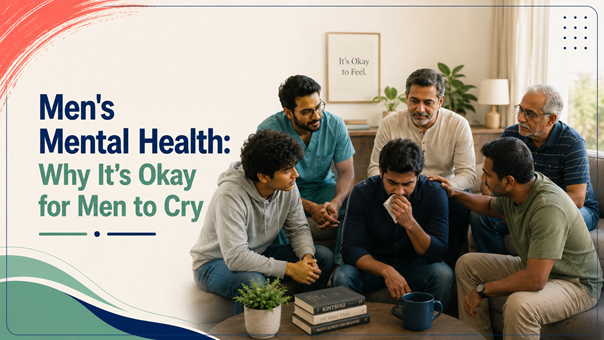
Why It’s Okay for Men to Cry
One of the most common questions raised during conversations about men’s emotional wellbeing is:
“Is it okay for men to cry?”
The answer is simple.
Yes.
Not because crying is expected of every man.
But because crying is a natural human response to emotion—not a measure of masculinity.
People cry when they experience grief.
They cry when they feel relief after prolonged stress.
They cry during moments of joy, disappointment, loss, gratitude, or emotional overwhelm.
These responses are part of being human, not part of belonging to one gender.
The more important question, however, is not whether men cry.
It is whether they feel safe expressing what they are experiencing in whatever healthy way works for them.
For some, that may involve tears.
For others, it may mean speaking with a trusted friend, journaling, engaging in physical activity, practising mindfulness, or seeking professional support.
Healthy emotional expression does not look the same for everyone.
What matters is not the method.
What matters is that emotions are acknowledged rather than ignored.
When emotions remain unaddressed for prolonged periods, they often find expression in other ways—through chronic stress, burnout, irritability, emotional withdrawal, relationship difficulties, or declining physical and psychological wellbeing.
Encouraging emotional honesty does not weaken resilience.
It strengthens it.
True resilience is not about pretending that pain does not exist.
It is about recognising challenges early, responding to them constructively, and seeking support before they become overwhelming.
That is why the conversation around men’s mental health should move beyond asking whether it is acceptable for men to cry.
Instead, we should ask a more meaningful question:
Are we creating environments where men feel safe enough to express their emotions without fear of judgement?
When the answer becomes yes, emotional wellbeing becomes easier to protect—not only for men, but for everyone around them.

Awareness Has Increased—But Behaviour Has Not Always Changed
Over the past decade, conversations about mental health awareness have become more visible than ever before.
Organisations now speak openly about workplace wellbeing.
Educational institutions are investing in student support services.
Communities are encouraging conversations around emotional health.
Terms such as burnout, anxiety, psychological safety, and emotional resilience have entered mainstream discussions.
This increased awareness is an important and encouraging step.
However, awareness alone does not automatically translate into behavioural change.
Many men today understand that mental health matters.
They may encourage friends, family members, or colleagues to seek professional support when needed.
Yet when emotional struggles become personal, many still hesitate to seek help themselves.
The reason lies deeper than information.
Knowledge changes understanding.
Culture influences behaviour.
For generations, many boys have been taught that strength means handling problems independently, remaining emotionally controlled, and avoiding vulnerability.
These beliefs often continue into adulthood, making it difficult to recognise that asking for support can also be an act of strength.
As a result, emotional challenges are frequently addressed much later than they should be.
The issue, therefore, is not simply a lack of awareness.
It is the persistence of cultural beliefs that make help-seeking behaviour feel uncomfortable, even when support is available.
Why Culture Matters More Than We Often Realise
Across the world, organisations, educational institutions, and communities are investing more than ever before in mental health awareness.
Employee Assistance Programmes (EAPs) are becoming common.
Educational institutions are strengthening counselling services.
NGOs and community organisations are creating support networks.
Leaders are speaking more openly about wellbeing.
These developments are encouraging because they acknowledge that emotional wellbeing deserves attention.
However, having support systems in place does not automatically mean people feel comfortable using them.
Imagine an organisation that offers confidential counselling but where employees fear being seen as “less capable” if they seek support.
Or consider a student who knows counselling services are available but worries that asking for help might be interpreted as an inability to cope.
In both situations, the resource exists.
The confidence to access it does not.
This is where culture becomes more influential than infrastructure.
Support systems are important.
Culture determines whether those systems are used.
Psychological safety—the belief that people can express concerns, admit challenges, ask questions, or seek help without fear of judgement or negative consequences—is therefore one of the strongest predictors of whether mental health initiatives translate into meaningful action.
Creating psychologically safe environments is not simply about encouraging conversations.
It is about consistently demonstrating that emotional wellbeing is respected, supported, and valued.
When people trust that they will be treated with empathy rather than judgement, they are far more likely to seek support before emotional challenges become overwhelming.

The Hidden Impact on Educational Institutions
Educational institutions are not only places where knowledge is shared.
They are environments where young people develop confidence, identity, resilience, and lifelong coping skills.
Students carry far more into the classroom than textbooks.
They bring expectations.
Academic pressure.
Fear of failure.
Family responsibilities.
Financial uncertainty.
Questions about identity and purpose.
Relationship challenges.
These emotional experiences often remain invisible, yet they influence concentration, motivation, participation, and learning every day.
When emotional wellbeing is overlooked, institutions frequently notice only the outcomes.
Attendance begins to decline.
Class participation reduces.
Students appear disengaged.
Assignments are delayed.
Academic performance suffers.
Behavioural concerns increase.
These outcomes are often addressed as academic or disciplinary issues.
In many cases, however, they are also indicators of emotional distress.
Young men, in particular, may find it difficult to express emotional struggles because they have spent years learning that asking for help reflects weakness rather than wisdom.
As a result, many continue managing emotional burdens silently until those challenges begin affecting multiple aspects of their lives.
Supporting student mental health is therefore not separate from improving educational outcomes.
It is central to them.
When educational institutions create psychologically safe environments where emotional wellbeing is normalised, students become more likely to engage actively, collaborate effectively, seek support early, and develop resilience that extends well beyond the classroom.
Education is not only about preparing students for examinations.
It is about preparing them for life.
And emotional wellbeing plays an essential role in that preparation.

When Distress Is Mistaken for Strength
One of the greatest misconceptions surrounding men’s mental health is that emotional distress always looks obvious.
In reality, emotional struggles are often hidden behind behaviours that society rewards.
A student who never asks for help may be praised for independence.
An employee who works late every evening may be recognised for commitment.
A leader who never speaks about personal challenges may be admired for resilience.
Sometimes these behaviours genuinely reflect dedication and discipline.
At other times, they become ways of coping with emotional struggles that remain unseen.
Emotional suppression in men may present itself through:
- Withdrawal from relationships
- Irritability or persistent frustration
- Emotional numbness
- Excessive work or overcommitment
- Difficulty expressing emotions
- Reluctance to seek support
- Chronic stress and exhaustion
These behaviours are not always recognised as potential indicators of emotional distress because they often appear productive on the surface.
Yet beneath that appearance may be loneliness, anxiety, grief, burnout, or overwhelming pressure.
This highlights an important lesson for educational institutions, workplaces, and communities.
Performance alone is not always an indicator of wellbeing.
Someone may continue meeting expectations while privately struggling with significant emotional challenges.
Recognising emotional wellbeing therefore requires looking beyond visible performance and creating opportunities for meaningful conversations before emotional difficulties escalate into crises.
The Workplace Consequences of Emotional Suppression
The discussion around workplace mental health is often viewed as an employee wellbeing initiative.
In reality, it is equally a leadership, organisational, and business effectiveness issue.
Every organisation depends upon people making thoughtful decisions, collaborating effectively, adapting to change, and building healthy professional relationships.
These outcomes are directly influenced by emotional wellbeing.
When emotional struggles remain unaddressed, organisations may begin noticing:
- Increased absenteeism
- Higher employee turnover
- Leadership fatigue
- Reduced engagement
- Communication breakdowns
- Lower productivity
- Burnout
- Team conflict
These challenges rarely emerge suddenly.
They often develop gradually while employees continue performing despite carrying significant emotional burdens.
According to the World Health Organization, supportive and mentally healthy workplaces contribute not only to employee wellbeing but also to organisational productivity, engagement, and sustainable performance.
Mental wellbeing should therefore not be viewed as an optional employee benefit.
It is an investment in healthier people, stronger leadership, and more resilient organisations.
Moving from Crisis Response to Early Intervention
Across educational institutions, workplaces, NGOs, and communities, one pattern emerges consistently.
Visible problems often begin as invisible struggles.
Burnout rarely happens overnight.
Emotional isolation develops gradually.
Stress accumulates quietly.
Many individuals continue functioning while silently carrying emotional burdens that remain unnoticed until they begin affecting relationships, academic performance, workplace effectiveness, or physical health.
This is why the future of mental health awareness cannot depend solely on responding to crises.
It must also focus on recognising emotional challenges early and creating environments where seeking support feels natural rather than exceptional.
Early intervention is not simply about identifying problems sooner.
It is about creating systems that make it easier for people to ask for help before challenges become overwhelming.
For organisations, this means training leaders to recognise early warning signs, fostering emotionally intelligent conversations, and building psychologically safe teams.
For educational institutions, it involves equipping educators to recognise behavioural changes, encouraging peer support, and ensuring students know where and how to seek professional help.
For communities, it means normalising conversations around emotional wellbeing and reducing the stigma that often delays help-seeking behaviour.
When support becomes proactive rather than reactive, individuals are more likely to receive timely guidance, recover more effectively, and continue contributing meaningfully to their families, workplaces, and communities.
Building Systems Rather Than Isolated Initiatives
Mental health awareness campaigns play an important role in starting conversations.
Workshops encourage reflection.
Training programmes build knowledge.
Awareness days increase visibility.
These initiatives are valuable.
However, sustainable change requires more than isolated events.
Real transformation occurs when emotional wellbeing becomes part of everyday systems rather than occasional activities.
Educational institutions can integrate wellbeing into student development programmes, faculty training, and campus culture.
Organisations can embed workplace mental health into leadership development, performance conversations, employee engagement strategies, and organisational policies.
Communities can strengthen support networks, encourage collaboration, and create accessible pathways to professional care.
The question therefore shifts from:
“How do we organise another awareness event?”
to
“How do we build systems that consistently support emotional wellbeing?”
This systems-based approach creates lasting change because it influences daily experiences rather than isolated moments.
Culture is not built through one campaign.
It is built through repeated actions, consistent leadership, and environments that reinforce psychological safety every day.
A Shared Responsibility
Mental health is often experienced individually.
But it is shaped collectively.
Families influence how children understand emotions.
Educational institutions shape how students respond to challenges.
Workplaces influence whether employees feel psychologically safe.
Communities determine whether seeking help is encouraged or stigmatised.
Mental health professionals provide the expertise needed to guide individuals towards healthier coping strategies and recovery.
No single person or institution can strengthen men’s mental health alone.
Meaningful progress requires collaboration.
When families encourage emotional honesty, educational institutions prioritise student wellbeing, workplaces invest in psychologically safe cultures, and communities promote early help-seeking, emotional resilience becomes easier to build.
Supporting men’s emotional wellbeing is therefore not simply an individual responsibility.
It is a collective commitment to creating environments where people feel safe to seek support, grow through challenges, and contribute meaningfully to society.
Turning Awareness into Action
At ICHARS Support Foundation (ISF), we believe awareness is only the beginning.
Real impact is created when awareness translates into structured, sustained action.
The Foundation works towards strengthening mental health awareness, encouraging early help-seeking behaviour, improving access to professional support, and building emotionally supportive environments across educational institutions, workplaces, and communities.
Through awareness initiatives, workshops, educational programmes, capacity-building efforts, institutional partnerships, and community engagement, ISF seeks to strengthen not only individuals but also the systems that influence their wellbeing.
This reflects a simple yet powerful belief:
Strong systems create resilient people.
When institutions become psychologically safer, individuals are better equipped to learn, work, lead, and thrive.
A Question Worth Asking
As conversations around men’s mental health continue to evolve, perhaps the most important question is no longer whether emotional wellbeing matters.
The more meaningful question is:
How intentionally are we creating environments where emotional wellbeing is supported every day?
Ask yourself:
- Do people feel safe discussing emotional challenges?
- Do students and employees know where to seek support?
- Are leaders equipped to build psychological safety?
- Are systems in place to encourage early intervention rather than crisis response?
- Does our culture recognise that resilience and vulnerability can coexist?
The answers to these questions often reveal where meaningful change begins.
Because investing in mental wellbeing is not simply about preventing distress.
It is about enabling people to learn better, lead better, collaborate better, and live healthier, more fulfilling lives.
The question has never been whether men are capable of being resilient.
They are.
The real question is whether the systems around them make it safe to combine resilience with emotional honesty.
Because the strongest communities are not those where people never struggle.
They are the communities where people never have to struggle alone.
Frequently Asked Questions (FAQs)
1. What is men’s mental health?
Men’s mental health refers to the emotional, psychological, and social wellbeing of men. It includes how men understand emotions, cope with stress, build relationships, make decisions, and seek support when needed.
2. Why is it okay for men to cry?
Crying is a natural human response to emotions such as grief, relief, joy, or stress. Emotional expression is not a sign of weakness; it is one of many healthy ways people process difficult experiences.
3. Why do many men hesitate to seek help?
Many men grow up with cultural expectations that equate strength with emotional self-reliance. These beliefs can make asking for support feel uncomfortable, even when they recognise its importance.
4. How does emotional suppression affect workplaces?
When emotional challenges remain unaddressed, organisations may experience burnout, absenteeism, reduced engagement, communication challenges, leadership fatigue, and lower productivity. Creating psychologically safe workplaces benefits both employees and organisations.
5. What role do educational institutions play in supporting men’s mental wellbeing?
Educational institutions can promote emotional wellbeing by creating psychologically safe learning environments, strengthening counselling services, training educators to recognise early warning signs, and encouraging students to seek support without stigma.
References
- World Health Organization (WHO). Mental Health. WHO recognises mental health as an integral part of overall health and emphasises the importance of prevention, early intervention, and supportive environments.
- World Health Organization (WHO). Mental Health at Work. WHO highlights that psychologically safe workplaces improve employee wellbeing while strengthening organisational performance and productivity.
Learn More
To learn more about the work of ICHARS Support Foundation, explore our initiatives in mental health awareness, capacity building, institutional partnerships, and community engagement.
Together, we can move beyond awareness and create environments where seeking support is recognised not as a weakness, but as an expression of wisdom, courage, and resilience.
Explore More from Beyond the Narrative
Continue exploring evidence-informed perspectives on mental health, emotional wellbeing, and the systems that shape our lives.
Toxic Positivity: Why “Just Be Positive” Can Harm Mental Health | Beyond the Narrative